In short
- A geyser installed to SANS 10254 has up to three separate pipes ending outside: the expansion valve drain, the T&P valve drain and the drip-tray drain. Find out which one is dripping first.
- A drip for an hour or so while the geyser heats is normal; the City of Cape Town puts it at up to 2 litres a day. A drip that never stops points to a worn valve or more mains pressure than the valve can hold back.
- Hot water or steam from the T&P pipe is the dangerous one. Switch the geyser off at the distribution board, keep clear of the outlet and call a plumber.
- Water from the drip-tray pipe means the cylinder or a fitting is leaking. Switch off, close the geyser's cold isolating valve and have it seen the same day.
A geyser overflow pipe dripping outside the house is easy to misread. Some drips are the geyser working as designed. Others mean a valve has worn out, the mains is pushing harder than the geyser can take, or the cylinder has started to leak. From the garden they look much the same, so what decides it is which pipe is dripping, when it drips and whether the water is warm. Below, each pipe and each kind of drip is matched to what it means and how soon it needs a plumber in Brackenfell.
Three Geyser Overflow Pipes, Three Different Jobs
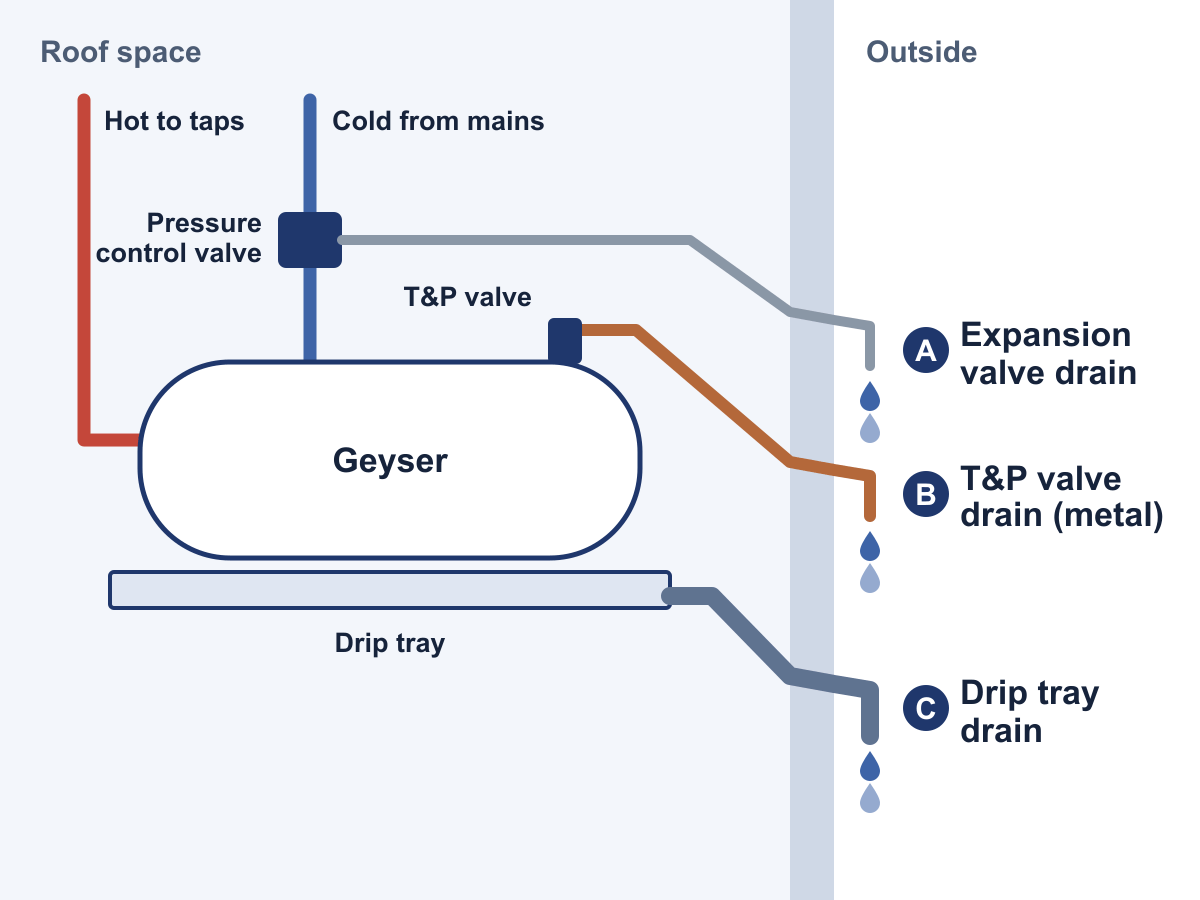
A high-pressure electric geyser has three safety items that each need a way to get rid of water. The Institute of Plumbing South Africa's SANS 10254 compliance tables say the discharge pipes from the T&P valve and the expansion valve must never be joined to other discharge pipes and must end where they are visible outside the building, and that the drip-tray pipe must also discharge outside, easily seen. That separation is what lets you tell from outside which part of the system is talking. The drawing at the top of this page shows how the three usually run.
A: the expansion valve drain
Mains water first passes a pressure control valve on the cold supply, the valve that, in Kwikot's words, "reduces incoming mains pressure to protect the geyser". An expansion relief valve sits with it, often in the same body. Heated water expands, and with the cold supply closed behind it the extra volume has nowhere to go, so the expansion valve lets a little out through this pipe. The City of Cape Town's leak guide says the drip "could continue for an hour or more, losing up to 2 litres a day" and "should stop when the temperature stabilises".
B: the T&P valve drain
The temperature and pressure valve is fitted to the cylinder itself. Kwikot describes it as a dual-purpose safety valve, there "to relieve overheated water" and "to relieve excess water pressure". Its discharge pipe must always be metal and must fall away from the valve. On a healthy system it stays dry.
C: the drip-tray drain
The tray under the geyser must cover the heater and the valves around it, with a drain that falls to the outside. It catches water from a cylinder or fitting that has started to leak, and its pipe is how you find out before the ceiling does.
To tell them apart, follow each pipe back towards the geyser and note which one is wet. The T&P pipe is the one that has to be metal, and warm water should be treated as coming from it until a plumber shows otherwise. If two pipes have been joined, or one ends inside the roof, mention it when you call.
What Each Geyser Overflow Pipe Drip Pattern Means
| What you see | Pipe | What it usually means | How urgent |
|---|---|---|---|
| Drips for an hour or so after the geyser switches on or after showers, then stops | A | Normal expansion while the water heats | Not urgent |
| Cold drip or trickle, day and night | A | A worn pressure control or expansion valve, or more incoming pressure than it can hold back | Book a plumber this week |
| Warm or hot water, or steam | B | The water is overheating, or pressure in the cylinder has passed the valve's rating | Switch off at the DB now and call |
| Water running from the tray pipe | C | The cylinder or a fitting inside the tray is leaking | Switch off, close the cold isolating valve, same day |
Kwikot draws the line by volume: "A small amount of discharge during a heating cycle is normal thermal expansion. More than about four litres a day, or a constant trickle, is not." Beyond that it names three causes: a T&P valve that is passing, a failed pressure control valve, or a thermostat set too high. If you are unsure which side of the line you are on, stand a bucket under the outlet for a day and measure what collects.
Kwikot's guide is just as blunt about what not to do: "Do not cap or plug a relief pipe. It is the tank's last line of defense and blocking it converts a leak into a burst."
Why Brackenfell Mains Pressure Can Keep A Geyser Overflow Pipe Dripping
A constant cold drip from pipe A is where the City's network comes in. In its December 2017 water rationing guide, the City said its system normally supplies water at between 2.4 and 9 bar. Kwikot says 600 kPa (6 bar) geysers are the standard for most South African installations, with 400 kPa (4 bar) units used where pressure is lower or already reduced. At the top of the City's range the street can push half as hard again as a 600 kPa cylinder is built for. The pressure control valve absorbs that difference. When it wears, the expansion valve beside it starts relieving pressure all day instead of only during heating.
Street pressure also moves. The City manages its network as about 280 pressure management zones, and Brackenfell has had steady work on its section:
- 2 September 2025: the main to Protea Village was shut off for a test while three control valves and two fire hydrants were installed.
- 9 December 2025: Welgeleë, Welkom and George Roads in Vredekloof East were off from 09:00 to 18:00 while part of the supply main was upgraded.
- 10 February 2026: zero-pressure tests for zone management investigations across Brackenfell, Brackenfell South, Protea Hoogte, the Bracken Nature Reserve area and Protea Village, with the City warning of low pressure or no water.
Work like this can leave the pressure at your meter unchanged, or move it, and a pressure control valve that coped with the old figure may not cope with a new one. If the drip started just after a shut-off in your street, note the date for the plumber.
Height matters too. Brackenfell is flanked by the Bottelary Hills to the south-east, with Kanonkop the highest point in the town at 177 m, and the City's guide explains that within one pressure zone the lower-lying properties get the higher pressure. Our water pressure repairs page explains how pressure is measured at the meter, and the Protea Heights page covers what to watch for after zone work.
What A Dripping Geyser Overflow Pipe Costs On Your City Bill
No water restrictions have applied in Cape Town since 1 November 2020, so homes pay the City's lowest, no-restriction "Water Wise" tariff. From 1 July 2026 a single residential property pays, including VAT, R25.05 per kl of water for the first 6 kl a month, R34.42 from 6 to 10.5 kl and R54.60 from 10.5 to 35 kl. Sanitation is charged on 70% of that water, at R18.28, R25.11 and R42.18 per kl in matching steps. Together, each extra kilolitre costs about R52.00 for a house in the second step and R84.13 for one in the third. Fixed monthly charges do not change with a drip.
| Drip | Litres a day | kl a month | Extra a month, step 2 | Extra a month, step 3 |
|---|---|---|---|---|
| Normal expansion, the City's upper figure | 2 | 0.06 | R3.12 | R5.05 |
| Kwikot's limit for normal | 4 | 0.12 | R6.24 | R10.10 |
| Steady drip, about one drop a second | 28.8 | 0.86 | R44.93 | R72.68 |
| Thin trickle that fills a 1-litre jug in 10 minutes | 144 | 4.32 | R224.63 | R363.42 |
Assumptions: a 30-day month; one drop a second uses the US Geological Survey's estimate of about 3,000 drips to the litre; the trickle is an example, not a measurement. The City is due to decide at the end of October 2026 whether restrictions are needed, and restriction tariffs are higher. A big trickle can also tip the whole month into a higher step, which, the City's leak guide notes, "automatically pushes up your waste water bill too". To price your own drip, catch it for an hour, multiply by 24 for litres a day, then by 30 and divide by 1,000 for kilolitres a month.
How Serious Is Your Geyser Overflow Pipe Drip, And What To Do Now
- Short drip while heating (A): nothing needs fixing. The City suggests leading that water to the garden or catching it for plants. Do not cap or block the pipe.
- Constant cold drip (A): the geyser can stay in use, but book it in. The valve meant to keep mains pressure off the cylinder is worn or overwhelmed.
- Hot water or steam (B): switch the geyser off at the distribution board, keep children and pets away from the outlet, leave the valve lever alone and call a plumber.
- Drip-tray pipe running (C): switch off at the board, close the cold isolating valve at the geyser (or the main stoptap), and check the ceiling below for damp. If water is coming through, treat it as an emergency call-out.
The overflow pipes are part of your own installation, so they are a plumber's job, not the City's. The City's fault line is for its network: a burst main, no water, or pressure gone in the whole street. Report those on WhatsApp at 060 018 1505, on 0860 103 089 (option 2) or to water@capetown.gov.za.
What A Plumber Checks When The Geyser Overflow Pipe Keeps Dripping
- Incoming pressure: a gauge at the meter or stoptap, still and with water running, to see what the street is delivering.
- Matching ratings: the IOPSA tables say the pressure control, expansion and T&P valves should share one rating, and none may exceed the cylinder's. A mismatch is worth ruling out early.
- The pressure control and expansion valve: whether it holds its set pressure, and whether the relief side passes water when it should be shut.
- The thermostat: whether it switches off at its setting. Kwikot recommends 55 to 60°C.
- The pipes, tray and cylinder: every discharge pipe separate, falling and visible, the T&P pipe in metal, the drip tray and its drain clear, the cylinder and fittings dry, and vacuum breakers on the hot and cold sides.
Kwikot's advice for a drip beyond normal is to have "the incoming pressure tested and the valves replaced as a pair". Testing first tells you whether the cause is the valve, the pressure or both, so you do not pay for a part that will soon be dripping again. That is where our geyser repair visits in Brackenfell start: readings taken and shown to you, then a written price for the part at fault. If the meter-side pressure is the problem, water pressure repairs covers the next step.
Questions Brackenfell Homeowners Ask
Is it normal for a geyser overflow pipe to drip?
Yes, for a while each time the geyser heats. The City of Cape Town says the expansion valve can drip for an hour or more and lose up to 2 litres a day, stopping once the temperature settles. A drip that never stops, or more than about four litres a day by Kwikot's measure, is not normal.
How do I stop my geyser overflow pipe from dripping?
Never by capping or blocking it: Kwikot warns that blocking a relief pipe "converts a leak into a burst". A normal expansion drip only needs collecting. A constant drip stops when its cause is fixed, which means a plumber testing the incoming pressure, the valves and the thermostat.
Why is hot water coming out of my geyser overflow pipe?
Hot water usually comes from the T&P valve, which opens when the water overheats or the pressure in the cylinder passes the valve's rating. Switch the geyser off at the distribution board, keep everyone away from the outlet, leave the valve alone and call a plumber.
Can I still use water if my geyser overflow is dripping?
With a cold drip from the expansion valve, yes. With hot water or steam from the T&P pipe, switch the geyser off and leave it off until it has been checked. If the drip-tray pipe is running, also close the cold isolating valve at the geyser; the cold taps elsewhere in the house keep working.
Why did my geyser start dripping after the water came back on in Brackenfell?
A shut-off or pressure test can leave the pressure at your meter unchanged or move it, and a tired pressure control valve may not cope with a new figure. Brackenfell has had several such jobs, including zone management tests on 10 February 2026. Note the date the drip started and have the pressure measured.
Sources
- City of Cape Town: DIY Guide to Finding and Fixing Water Leaks (hot water cylinders, tariff blocks, fault channels) (November 2022)
- Kwikot: The Complete Electric Geyser Guide for South Africa (normal discharge, causes of a constant trickle, pressure ratings, thermostat range) (2026)
- Kwikot: FI Temperature and Relief Valve, 400 kPa (what the T&P valve does)
- Institute of Plumbing South Africa: Plumbing compliance SANS 10254, compliance tables for electric storage water heaters (March 2017)
- City of Cape Town: Guide on Water Rationing (normal pressure of 2.4 to 9 bar; pressure within a zone) (December 2017)
- City of Cape Town: Protecting every drop: City interventions are reducing water losses (about 280 pressure management zones) (19 January 2026)
- City of Cape Town: Planned water supply maintenance for 1 to 4 September 2025 (Protea Village control valves) (31 August 2025)
- City of Cape Town: Planned water supply maintenance for 8 to 11 December 2025 (Vredekloof East main upgrade) (5 December 2025)
- Cape Town Etc: Expect water supply disruptions in these Cape Town areas this week (Brackenfell zone management investigations) (7 February 2026)
- Wikipedia: Brackenfell (Bottelary Hills, Kanonkop)
- City of Cape Town 2026/27 tariffs: Water, Level Water Wise (No Restriction), Annexure 55 (from 1 July 2026)
- City of Cape Town 2026/27 tariffs: Sanitation, Level Water Wise (No Restriction), Annexure 60 (from 1 July 2026)
- City of Cape Town: City to move to no restriction, water-wise tariff from 1 November (20 October 2020)
- EWN: City of Cape Town to make a decision in October over possible water restrictions (17 September 2026)
- US Geological Survey: Drip calculator (about 3,000 drips to the litre)
- City of Cape Town: Good news: WhatsApp is back for water and electricity fault reporting and service requests (19 September 2025)
Written by The Brackenfell Plumbers, a plumber in Brackenfell working across Brackenfell, Protea Heights, Kuils River and Kraaifontein. This is general guidance; a plumber on site can tell you what applies to your geyser and your property.